
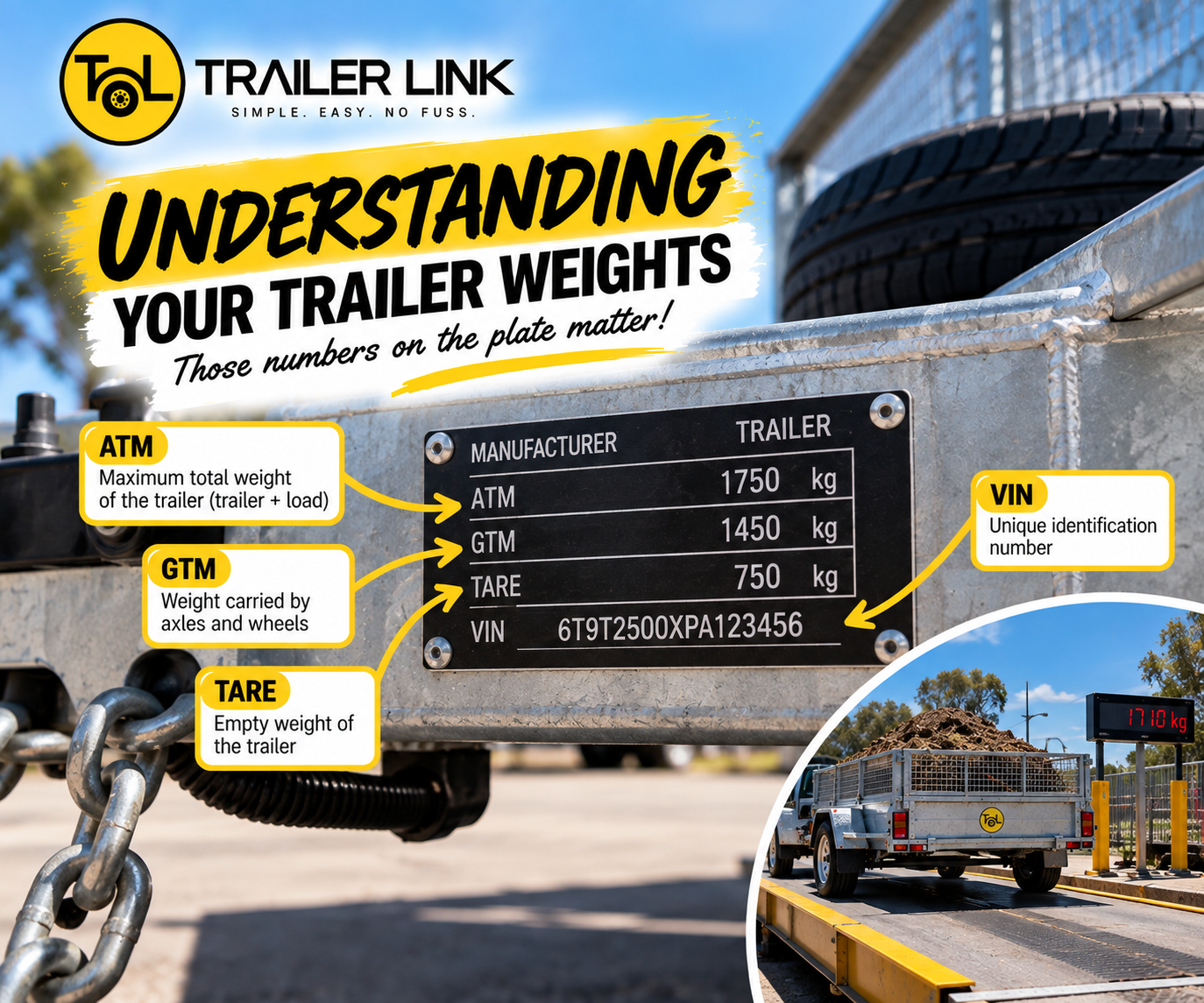

Every trailer has a metal plate on the drawbar or frame with a handful of numbers on it. Most people never read it. Then a load goes on, the back of the ute sags, the steering feels light, and someone wonders if that’s normal.
It isn’t. Those numbers decide what you can carry, what you can tow, and what a police officer or insurer will care about if something goes wrong. Here’s what each one means, in plain words.
The Numbers on the Plate
Look for these on the compliance plate:
- Tare – The weight of the empty trailer. Nothing on it, no gas bottles, no spare tyre extras.
- ATM (Aggregate Trailer Mass) – The most the trailer can weigh in total, including its own weight and everything on it, when it’s not hitched to anything. This is the number that matters most.
- GTM (Gross Trailer Mass) – The weight the trailer’s axles and wheels carry when it’s hitched to your vehicle. It’s the ATM minus the weight sitting on the tow ball.
- Payload – What you can actually load. Work it out with ATM minus tare.
- Ball weight (tow ball download) – The downward push the drawbar puts on your tow ball.
Example: a trailer with a 750 kg tare and a 1,750 kg ATM has a payload of 1,000 kg. That’s the ceiling, not a target.
What 1,000 kg Actually Looks Like
A cubic metre of most things weighs more than people expect. Rough guides:
- Dry garden soil – about 1,000 to 1,300 kg per cubic metre
- Wet soil or clay – can push past 1,600 kg per cubic metre
- Mulch – around 300 to 500 kg per cubic metre, lighter, but wet mulch after rain adds up fast
- Sand and gravel – 1,400 to 1,800 kg per cubic metre
- Bricks and pavers – a full pallet can be well over 1,000 kg
That’s why a small box trailer can be legal when it’s full of green waste and overloaded when it’s a third full of wet soil. Volume is not weight. If you’re loading dense stuff, load less of it.
Ball Weight: The One Everyone Guesses At
Ball weight is the pressure on the back of your tow vehicle. A rough rule is to aim for around 10% of the loaded trailer weight on the ball, and check the maximum figure in your vehicle handbook and on your tow bar, because it’s often lower than people assume.
Too little and the trailer can sway, the classic fishtailing that gets worse the faster you go. Too much and the rear of the car sits low, the headlights point at the sky, and the front end loses grip.
How to fix it:
- Load heavy items over the axle, slightly forward of centre – not at the very back
- Tie everything down so it can’t shift – a load that slides backwards changes your ball weight mid-trip
- Use a ball weight scale or a simple bathroom scale and a stack of blocks if you want a real reading, not a guess
Your Trailer Sets the Real Limit
The trailer’s ATM is only half the story. Your tow vehicle has its own limits, and the lowest number wins.
- Braked towing capacity – the most your vehicle is rated to tow with trailer brakes fitted. Check the handbook or the vehicle’s compliance information.
- Unbraked towing capacity – much lower, and only relevant to light trailers.
- Tow bar rating – the tow bar has its own rating and it can be lower than the vehicle’s.
- Gross Combination Mass (GCM) – the most the vehicle and trailer can weigh together, fully loaded. People forget this one.
Quick check before you book: vehicle towing capacity, tow bar rating, and GCM. Then compare each against the trailer’s ATM, not its tare. The lowest of those figures is your limit.
Brakes: Where Weight Changes the Rules
In Australia, the weight of the trailer decides whether it needs brakes. As a general guide:
- Up to 750 kg ATM – brakes usually aren’t required
- Over 750 kg ATM – brakes are required
- Over 2,000 kg ATM – brakes on all wheels and a breakaway system are generally required, so the trailer stops if it comes off the tow bar
Rules vary a little between states, so check your own state’s road authority for the current detail. If you’re hiring, the trailer will already be set up to suit its rating. Ask the team if you’re unsure how the brake controller or breakaway cable connects to your vehicle.
Simple Ways to Stay on the Right Side
- Read the plate before you load. Take a photo of it on your phone.
- Load the trailer, then weigh it. A public weighbridge is cheap, and you’ll find several around Melbourne and in regional areas. If you’re carrying soil, rubble or machinery, use one.
- Don’t count on “it felt fine.” Overloaded trailers feel fine until you brake hard or hit a bad patch of road.
- Remember that fines and insurance problems follow the driver. If you’re over the limit, that’s on you, not the trailer’s owner.
- When in doubt, do two trips. Slower, but you get there in one piece.
The Short Version
Tare is the empty weight. ATM is the maximum total weight. Payload is what’s left for your gear. Ball weight sits around 10% of the load and needs to be set right. Your vehicle’s towing capacity, tow bar rating and GCM are the real limits, whatever the trailer says it can do.
Not sure whether your vehicle can pull the trailer you have in mind? Get in touch with the TrailerLink team with your vehicle make, model and year, and we’ll tell you what suits it. Then book your trailer.
0 Comment