
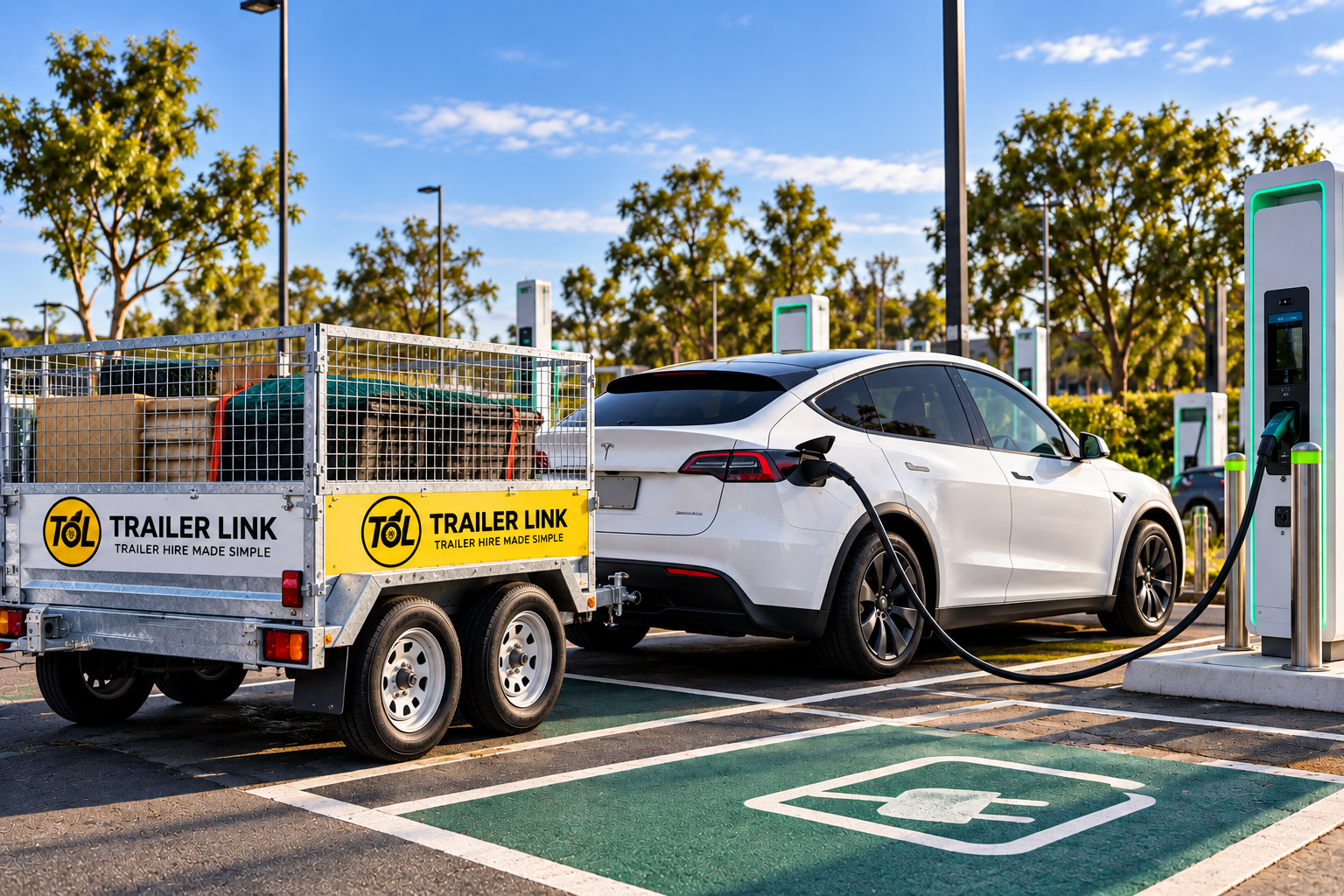

More EVs and plug-in hybrids are turning up in driveways, and a fair few owners are finding out the same thing. The car is quick, quiet and cheap to run, then they hook a trailer on and the range number on the dash starts dropping like a stone.
Towing with an EV is doable. It just plays by different rules to a diesel ute. Here’s what to sort out before you hire a trailer.
Towing a Trailer With an Electric Car or EV Ute: What Changes
More EVs and plug-in hybrids are turning up in driveways, and a fair few owners are finding out the same thing. The car is quick, quiet and cheap to run, then they hook a trailer on and the range number on the dash starts dropping like a stone.
Towing with an EV is doable. It just plays by different rules to a diesel ute. Here’s what to sort out before you hire a trailer.
Check the Tow Rating First (It’s Often Lower Than You’d Think)
A lot of EVs sold in Australia are rated to tow less than a similar-sized petrol or diesel car. Some can’t tow at all. Others are limited to a small unbraked trailer.
Before you book anything:
- Check the braked and unbraked towing capacity in the handbook or on the compliance plate
- Confirm a tow bar is fitted or approved for your model. Some manufacturers only approve their own accessory tow bar, and a cheap aftermarket one can cause warranty and insurance trouble
- Check the maximum ball weight. Some EVs have a low limit, so a heavy drawbar can put you over it before you’ve loaded a thing
- Check the GCM (the most the car and trailer can weigh together). The weight of the battery already eats into it
If the handbook says no towing, believe it. Ask your dealer if you’re unsure.
Expect Your Range to Drop, a Lot
Pulling a trailer adds weight and wind drag, and an EV feels both straight away. Real-world towing range commonly falls by around a third to a half compared with the same trip without a trailer. Bigger, boxier trailers and headwinds sit at the bad end of that.
Plan the trip around the lower number:
- Work out your range with the trailer on, not the number from the showroom
- Leave a buffer. Don’t plan to roll into a charger with 3% left
- Slow down. Drag climbs quickly with speed, so 90 km/h uses a lot less than 110 km/h
- Pick a lower trailer. A flat tray or low-sided box trailer pushes less air than a tall cage or enclosed van
- Cover the load. A tarp pulled tight beats a pile of loose rubbish flapping in the wind
Charging With a Trailer on the Back
This is the part that catches people out. Most public chargers are set up for a car nosing into a bay. A car with a 2.5 metre trailer behind it doesn’t fit.
- Look for pull-through bays or chargers at the end of a row where you can park along two spaces
- Check the charging app before you leave and mark a couple of backup sites
- Think about unhitching at a quiet spot if the charger is awkward, but only if it’s safe and the trailer won’t block anyone
- Charge to a higher level before you start, then top up on the road rather than relying on one big charge at the end
Regional runs need more planning. Gaps between fast chargers can be long once you’re out past the metro belt.
Brakes, Lights and Plugs
An EV is heavy and brakes partly by slowing the motor, so it feels different with a trailer behind. Two things are worth knowing.
- Trailer brakes still matter. Any trailer over 750 kg ATM needs brakes, and your car needs to be able to run them. Check how the trailer’s brake connection works with your vehicle
- Check the plug. Many EVs come with a 7-pin flat socket or no socket at all. Most box trailers use a 7-pin flat or a 12-pin, so you may need an adaptor. If you’re not sure which one you have, take a photo of your socket and send it through before you collect
Wiring isn’t something to guess at on a modern car. Some vehicles have sensitive electronics, and a bad connection can throw up fault warnings or cut out the trailer lights. If the lights don’t work, stop and sort it out before you drive.
Driving Tips for an EV and Trailer Combo
- Turn on the trailer mode if your car has one. Some EVs adjust the stability control and regen braking when towing
- Ease off the regen. Strong regenerative braking can be harsh with a trailer. If you can, set it lower so the car slows smoothly
- Leave extra following distance. Weight is weight, and the combo takes longer to stop than the car alone
- Check your mirrors and cameras. Reversing cameras and parking sensors can get confused by a trailer, so don’t trust them with a trailer on
- Take it easy on the first few kilometres. Pull over after 10 minutes and check the hitch, the safety chains and the lights
Quick Pre-Trip Checklist
- Towing capacity, ball weight limit and GCM checked
- Tow bar approved for your model
- Plug type confirmed
- Trip range worked out with the trailer on
- Charging stops planned, with pull-through bays marked
- Load tied down and covered
- Tyre pressures and safety chains checked
The Short Version
Check the towing rating, plan for a much shorter range, find chargers you can actually fit into, and confirm the plug before you collect. Do that and an EV can tow a trailer just fine for a weekend dump run, a garden clean-up or a trip to the beach.
Not sure whether your EV can pull the trailer you have in mind? Get in touch with the TrailerLink team with your vehicle make, model and year, and we’ll tell you what suits it. Then book your trailer.
0 Comment