
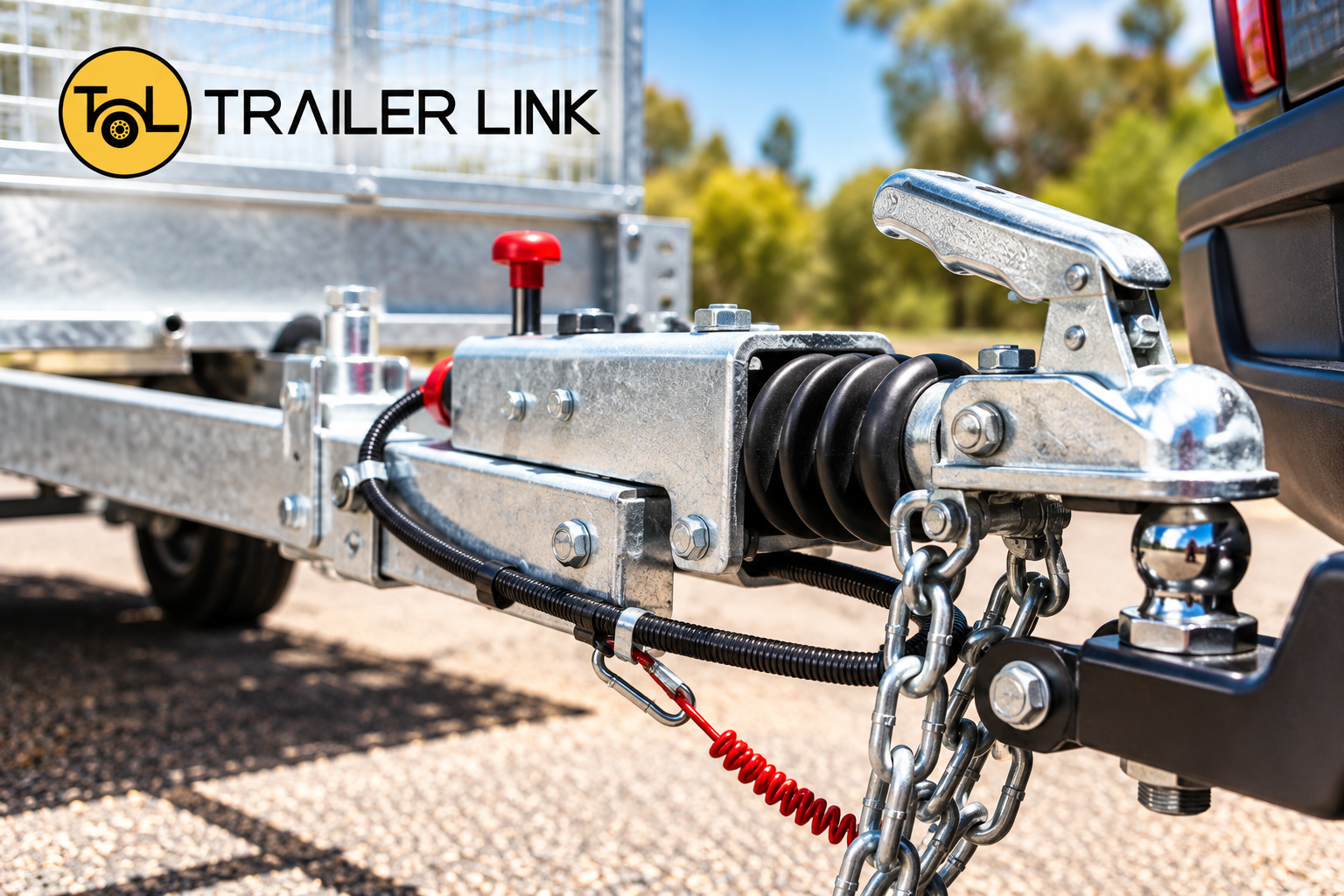

A trailer that weighs 2 tonnes loaded wants to keep going when you hit the brakes. If the trailer’s brakes aren’t doing their share, your ute is stopping its own weight plus the trailer’s push from behind.
Most people never think about trailer brakes until they need them. Here’s what you actually need to know.
When Does a Trailer Need Brakes?
The rule hangs on the trailer’s ATM (Aggregate Trailer Mass). That’s the maximum the trailer can weigh fully loaded, and it’s on the compliance plate.
As a general guide in Australia:
- Up to 750kg ATM: brakes aren’t required. Most small box trailers sit here
- Over 750kg, up to 2,000kg ATM: brakes are required on at least one axle
- Over 2,000kg, up to 3,500kg ATM: brakes on all wheels, plus a breakaway system
- Over 3,500kg ATM: the brake type changes (electric or air), and overrun brakes are out
Rules differ a little between states, so check with your state road authority (VicRoads in Victoria) before you buy or build. Your ATM is the number that counts, not what you happen to be carrying that day.
Overrun vs Electric: What’s the Difference?
Two systems cover almost every trailer you’ll hook up.
Overrun (mechanical) brakes
- Built into the coupling. When the tow vehicle slows, the trailer pushes forward into the coupling and that pushes the brakes on
- No wiring to the brakes, so nothing to plug in
- Common on tandem box trailers, tippers, boat trailers and most car trailers
- Weakness: they can’t be adjusted from the driver’s seat, and they work against you when reversing unless there’s a reverse lock
Electric brakes
- Wired to the tow vehicle and run through a brake controller in the cab
- You set the braking force and can hit a manual override if the trailer starts to sway
- Common on caravans, larger plant trailers and heavy car haulers
- Weakness: you need a controller fitted and a working 7 or 12 pin plug. No controller, no brakes
If you’re hiring a braked trailer, ask which type it has. If it’s electric, check your ute has a controller before you drive off. Many don’t.
The Breakaway System
If a trailer over 2,000kg ATM comes off the tow ball, the breakaway cable pulls a pin and locks the brakes on. It’s a short cable clipped to the tow vehicle, not the ball.
- Clip it to a solid point on the tow bar. Not the safety chain, not the ball
- Leave enough slack for tight turns, but not enough to drag on the road
- Check the battery on the breakaway unit if it has one. A flat battery means no brakes when you need them
Quick Brake Check Before You Head Off
Two minutes in the driveway beats finding out on the Monash Freeway.
- Look at the coupling: the overrun damper should move freely and not leak oil
- Check the cable and linkage: no rust, fraying or kinks
- Test the brake controller: hit the manual override and feel the trailer drag. Do this at walking pace in a car park
- Wheel spin test: jack a wheel up, spin it by hand. It should turn freely and then stop with the brakes applied. Grinding or a wobble means bearings or shoes are gone
- Check the breakaway: pull the pin per the manual. The brakes should lock. Reset it afterwards
- Smell and touch: after a short drive, wheel hubs should be warm, not too hot to touch. One hot hub means a dragging brake
If you see a puddle of fluid or hear metal on metal, don’t tow it. Get it looked at.
Driving With a Braked Trailer
- Brake earlier. Even with good brakes, your stopping distance goes up. Leave at least four seconds from the car in front
- Brake in a straight line. Hard braking in a corner is when trailers swing out
- Don’t ride the brakes down a hill. Drop a gear and let the engine hold you back
- Reversing with overrun brakes: the trailer may lock up. Most braked trailers have a reverse pin or lever on the coupling. Know where it is, and put it back before you drive forward
When Something Feels Wrong
Pull over somewhere safe and have a look if:
- The trailer pulls to one side under braking
- You hear a squeal or grind from one wheel
- The pedal feels longer than normal, or you’re using more of it
- There’s a burning smell from a hub
Brakes on a trailer are dull to maintain, but they’re the part you’ll be grateful for exactly once.
The Short Version
- Trailers over 750kg ATM need brakes. Over 2,000kg ATM also need a breakaway
- Overrun brakes are self-contained. Electric brakes need a controller in your ute
- A two-minute check before every trip catches most brake problems
- When hiring, ask what type of brakes it has and confirm your vehicle can run them
Not sure what you need for your load? Ask the TrailerLink team and we’ll point you to the right trailer. Then book your trailer.
Note for review: the ATM brake thresholds (750kg / 2,000kg / 3,500kg) are the general national guide but state rules vary slightly, so please confirm against the VicRoads page before publishing. The “pull the pin” breakaway test should be checked against the manufacturer’s manual wording. Also confirm which TrailerLink trailers are braked and what brake type they have. The website was not reachable from the automated run, so freshness was checked against the previous blog emails only.
0 Comment