
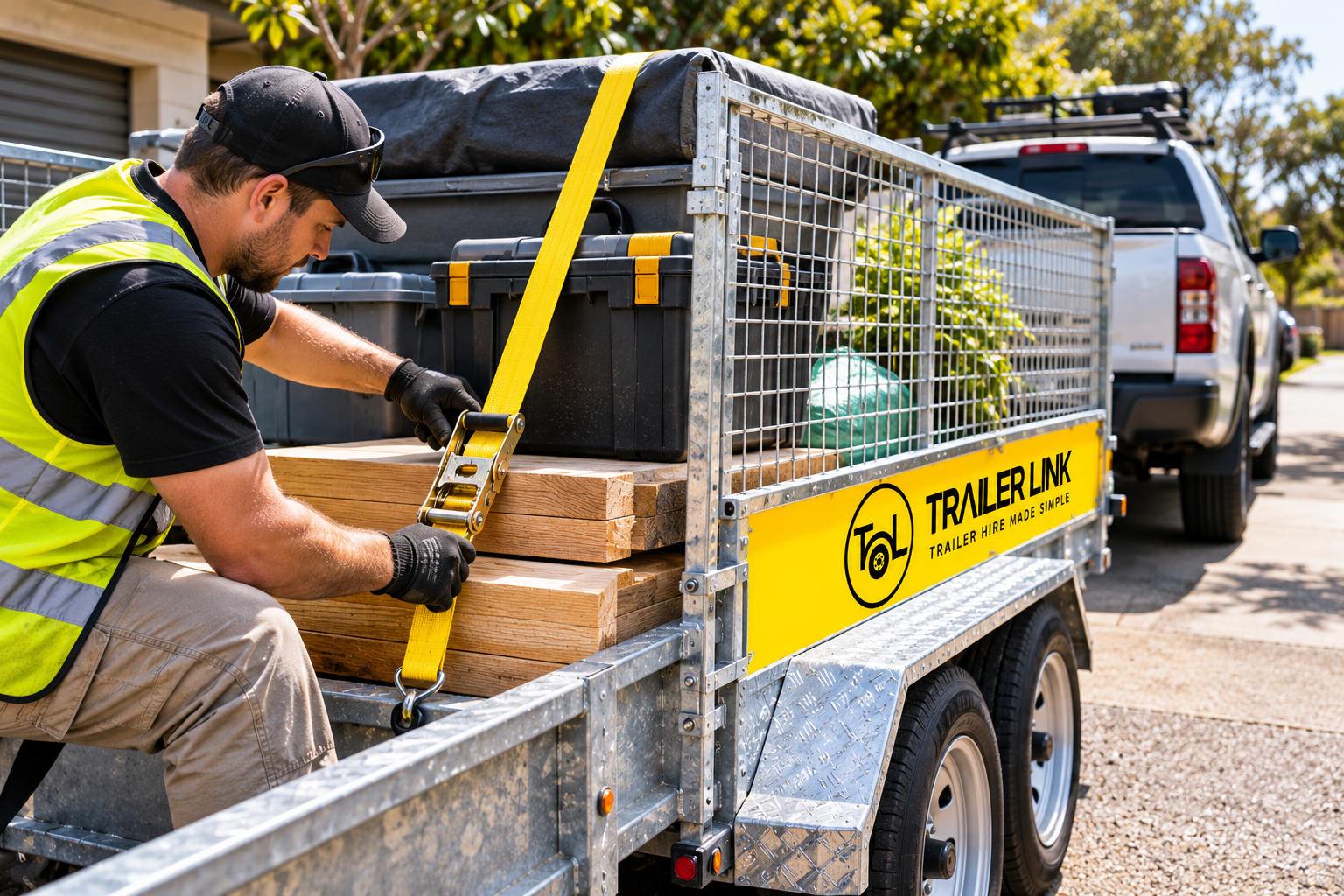

Most trailer trouble starts before you leave the driveway. Load it badly and the trailer will sway at 80, the ute will feel light on the front, and the first bump on the Princes Highway will tell you about it.
Good loading takes ten minutes. Here’s how to do it right.
Where the Weight Goes
Weight placement decides how a trailer tows. Get it wrong and you get sway. Get it right and you barely notice the trailer is there.
- Heavy stuff low and over the axle. Think pavers, tools, a bag of cement, the washing machine. Keep it as close to the floor as you can.
- About 60% of the load forward of the axle. This puts weight on the tow ball and keeps the trailer tracking straight.
- Aim for roughly 10% of the loaded trailer weight on the ball. A 1,000 kg load wants somewhere near 100 kg pushing down on the coupling. Check your vehicle’s maximum ball weight before you go.
- Light and bulky on top and at the back. Cardboard boxes, garden waste, flat-pack furniture.
- Spread it side to side. A trailer leaning to one side wears one tyre faster and pulls on the road.
Too much weight at the back lifts the tow ball. The trailer gets light on the hitch, starts to snake, and the ute steers like a shopping trolley. If the trailer is swaying, ease off the accelerator and don’t brake hard. Then stop and move the load forward.
Tie It Down Like You Mean It
A load that looks fine in the yard will move on the road. Brakes, corners and potholes all push stuff around.
- Use ratchet straps, not rope. Rope stretches and knots work loose. Look for straps with a rated working load, printed on the tag.
- Use at least two straps per item. One strap is a hope, not a restraint.
- Strap across the load and down to solid points. Hook onto the trailer’s tie-down rails or rings, not a loose mudguard or a side rail that flexes.
- Pad the corners. Straps cut into furniture and chew through cardboard. A folded towel or a corner protector saves the gear.
- Wrap loose things in a tarp, then strap the tarp. Garden waste, mulch and rubbish will go airborne at highway speed. A flapping tarp is a hazard too, so pull it tight.
- Chock or chain anything that can roll. Drums, wheelbarrows, mowers and bikes. Chock the wheels as well as strapping them.
Check the straps again after the first 10 minutes of driving. Loads settle and straps loosen. Pull over somewhere safe and take up the slack.
Loading by Trailer Type
Different trailers, different habits.
- Box trailer (6×4, 7×4): Keep the heaviest item in the middle, just ahead of the axle. Use the cage or tail gate as a back stop, not as a restraint.
- Tipper: Load evenly and never overload the front. A tipper loaded nose-heavy will shove the back of your ute down.
- Enclosed trailer: Easy to fill and hard to balance. Stack heavy boxes on the floor against the front wall and stop things sliding with packing straps or a load bar.
- Car trailer: Drive the vehicle on slowly, handbrake on, in gear, then strap all four wheels. Park the car so its weight sits just ahead of the axle line. Use proper wheel straps, and keep straps off the exhaust and brake lines.
- Motorbike trailer: Wheel chock, then compress the front forks slightly with the straps so the bike can’t bounce loose.
Check Your Numbers
A trailer has a maximum weight it can carry, and your vehicle has a maximum it can tow. Stay under both.
- The trailer’s ATM (aggregate trailer mass) is the total allowed weight, trailer plus load. It’s on the compliance plate.
- Your vehicle’s towing capacity is in the handbook or on the door pillar sticker.
- A cubic metre of wet soil weighs well over a tonne. Sand, gravel and concrete are heavy too. A trailer that looks half empty can be over its limit.
- If you’re not sure, load lighter and make two trips. Cheaper than a defect notice.
Before You Roll
A quick lap of the trailer before you leave:
- Load sitting low, centred, and not hanging past the back more than it should
- Every strap tight, with no loose ends flapping into the wheel
- Tarp pulled flat and tied at every corner
- Tail gate or ramp latched and pinned
- Lights, plug and safety chains checked
- Tyres look right under the weight
The Short Version
- Heavy low, 60% forward of the axle, about 10% of the weight on the ball
- Two straps minimum, ratchet not rope
- Tarp over loose loads and tie it down
- Check the straps after 10 minutes on the road
- Know your trailer’s ATM and your tow limit
Trailers at TrailerLink are booked online, collected from the depot and ready to load. Pick the size that suits the job, then book your trailer.
0 Comment