
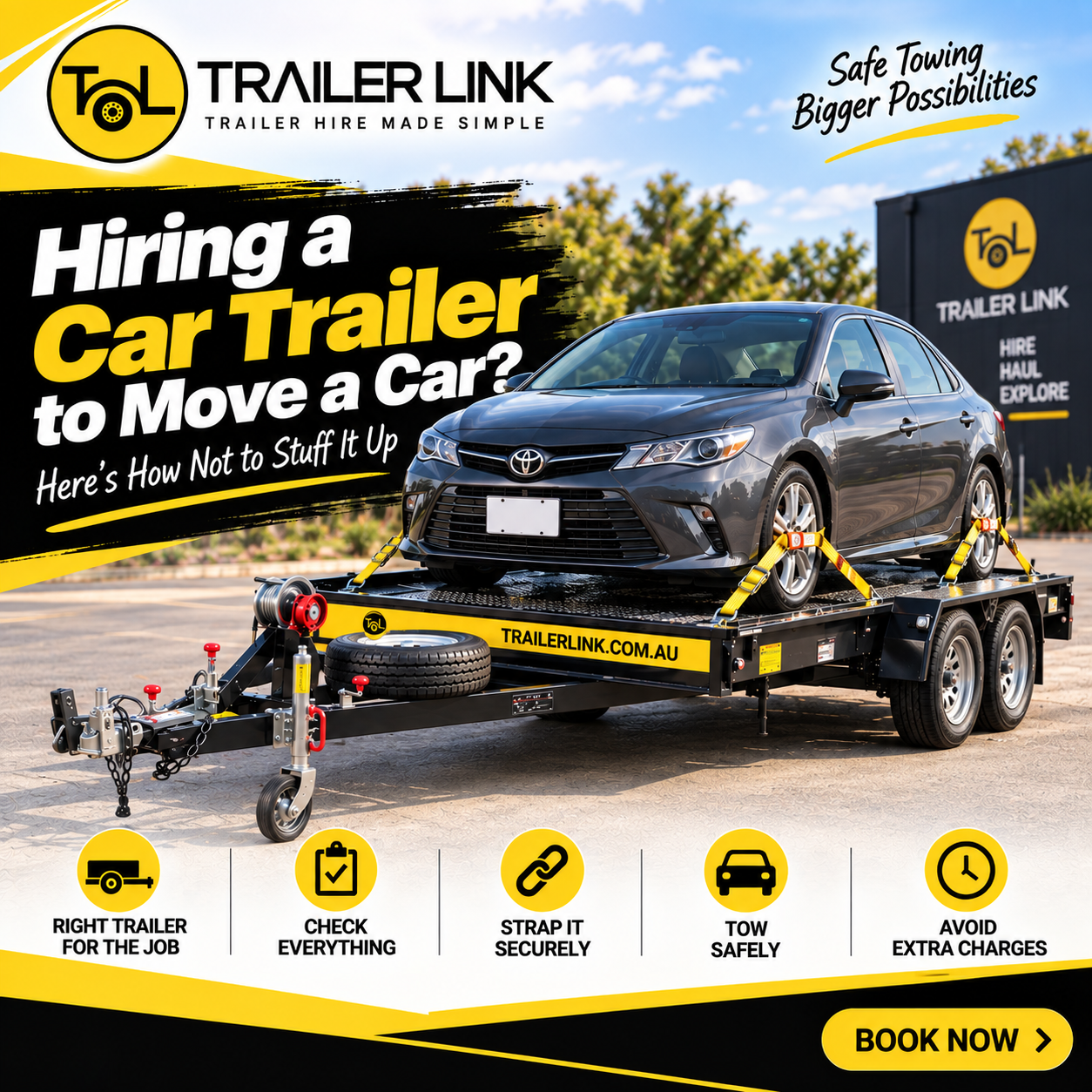

You’ve bought something off Marketplace three suburbs over, or your own car’s died and needs to get home, or you grabbed a bargain at auction and now you’ve got to collect it. Whatever the reason, hiring a car trailer to move an actual car is a different job to towing a box trailer full of green waste. The trailer’s heavier when loaded, the load doesn’t tie down the same way, and there’s a lot more that can go wrong between the yard and your driveway.
None of it is hard. Most of it just isn’t obvious until someone’s told you.
Tilt Trailer or Fixed Ramps? Get This Bit Right First
Car trailers aren’t all the same, and the type you hire changes how hard the rest of the job is.
- Tilt-tray trailers drop flat to the ground under the car’s weight, so there’s no ramp angle to fight. Good for low cars and anything that won’t drive under its own power.
- Fixed ramp trailers are cheaper to hire and fine for most 4WDs, utes, and everyday sedans that can drive on under their own steam.
- Single axle vs tandem matters more than people think. A tandem trailer tows flatter and more stable under a heavy car, and it’s what you want for anything over about 1.5 tonnes.
- Check the deck length, not just the weight rating. A trailer rated for your car’s weight can still be too short for its wheelbase, especially with 4WDs and utes.
If the car doesn’t run, doesn’t steer, or has flat tyres, say so when you book. That’s a tilt-tray job, not a ramp trailer with a rope and good intentions.
What to Check Before You Drive Off the Yard
Do this walk-around before you leave, not after you’ve noticed something’s wrong halfway home.
- Tow ball size matches your vehicle’s coupling. 50mm is standard, but confirm it, don’t assume it.
- Straps, chains, and a wheel chock or two are actually in the boot. Ask if they’re included, some hire places charge extra.
- Ramps lift, lock, and lower properly, and the pins or latches aren’t seized.
- Lights are plugged in and working before you leave the yard, indicators, brakes, and number plate light.
- ID, deposit, and any damage waiver are sorted at the counter, so you’re not doing paperwork with a trailer half-loaded.
- Spare tyre and jack for the trailer itself, not just your tow vehicle.
Five minutes here saves you a much longer, much worse five minutes later.
Loading the Car Without an Audience Gathering
This is the bit everyone’s slightly nervous about the first time, and the bit most likely to go wrong in front of witnesses.
- Line up dead straight before you drive or roll the car on. Even a slight angle gets exaggerated once you’re halfway up the ramp.
- Low cars need a shallow ramp angle or a tilt trailer. A front spoiler meeting a steep ramp is an expensive lesson.
- If the car doesn’t run, get two people. One to steer, one to push or guide from a winch, on flat, level ground, with the trailer’s own wheels chocked so it can’t roll.
- Strap the wheels, not just the frame. Wheel straps over the tyre, at all four corners, hold a car far more securely than a couple of chains hooked to whatever’s handy underneath.
- Snug the straps, then check them again after a few kilometres. They loosen as everything settles.
Towing a Loaded Car Is Not Like Towing a Box Trailer
A car on a trailer is heavy, and nearly all of that weight sits high and over the axle, not spread out like a load of mulch or furniture.
- Check your tow vehicle’s rated towing capacity against the combined weight of trailer plus car, not just the car alone. This catches more people out than anything else on this list.
- Get the tow ball weight right. Too little and you risk sway, too much and you’re overloading your own rear axle. Most hire trailers will tell you the ideal range, ask if it’s not obvious.
- Give yourself more stopping distance than feels natural. A loaded car trailer takes noticeably longer to pull up than an empty one.
- Take corners and roundabouts wider. The trailer tracks a tighter line than your car does, and a car on the deck adds height you might not be used to.
- If it starts to sway, ease off the accelerator, don’t brake hard, and let it settle before speeding back up.
Dropping It Off Without Copping Extra Charges
The job’s not done until the trailer’s back and the paperwork’s closed out.
- Unload on flat ground, straps off in the reverse order you put them on.
- Hose off mud and dirt if you’ve been off-road or on a work site. Most hire agreements charge a cleaning fee for a trailer returned dirty.
- Check straps and chains are back in the trailer, not still in your garage.
- Do a last walk-around and photograph the trailer before you hand back the keys. It takes thirty seconds and it’s the easiest way to avoid a dispute over a scratch that wasn’t yours.
- Return it on time. Late fees are usually charged by the hour, not rounded in your favour.
The Short Version
Match the trailer to the car, not just the weight limit. Check everything at pickup instead of on the side of the road. Strap the wheels, get the tow ball weight right, and give yourself more room to stop and turn than you would towing anything lighter.
Need a car trailer for a one-off job? Browse tilt-tray and ramp trailers near you on TrailerLink, or get in touch with our team if you’re not sure which one your car actually needs.
0 Comment